
Getting Ahead of the Call
Community Risk Reduction
Joliet’s Fire Chief John Koch on Turning CRR into a Mindset
At a recent Community Risk Reduction conference at ValparaisoUniversity in Indiana, Joliet Fire Department’s Deputy Chief John Koch challenged first responders to rethink their purpose: stop chasing the same calls and start preventing them. The vehicle for that shift, he argued, is Community Risk Reduction (CRR), not as a program, but as a department-wide mindset.
“We all have the same stories: the repeat addresses, the avoidable tragedies,” Koch said. “If you don’t get to the root cause, you’ll be back there tonight.”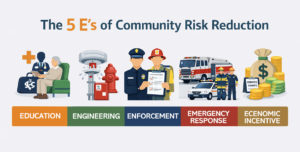
“Getting Ahead of The Call” was also the theme for Vision 20/20; a national strategic initiative focused on improving fire prevention, protection, and safety efforts within the United States fire service.
From reactive to proactive
Koch traced the fire service’s evolution, from bucket brigades to EMS and code enforcement, and admitted the profession hasn’t always kept pace with changing community needs. Handing out smoke alarms is good, he noted, but if the absence of alarms is a symptom of deeper issues, poverty, unstable housing, untreated illness, then boxes of detectors won’t solve the problem. CRR, in his telling, starts with data, conversations, and humility: learn the demographics and hazards, ask what neighborhoods actually need, align with city leaders’ priorities, and build coalitions that can act.
Lead the table, don’t go it alone
A through-line in Koch’s talk was collaboration with accountability. The department mapped local social-service providers, learned who truly delivered specific supports, and set expectations for follow-through. “We’re not trying to do everyone’s job,” he said. “We’re organizing the table, and then we check back to make sure help really reached the person.”
Concrete wins in Joliet
Koch highlighted several initiatives that grew from that approach:
- Community Mental Health Counseling. Paramedics were trained to de-escalate behavioral health crises, and through partnerships, Joliet residents now have access to in-person and telehealth counseling at no cost, removing barriers of availability, transportation, and cost. The model has since expanded beyond the city.
- Community Cares Program. Drawing on another county, Joliet paramedics refined and expanded their program beyond local government to include social, civic, and private sectors. Twice-monthly case conferences now convene 30–40 agencies to hand off complex clients in real time, close service gaps (like emergency car repairs that keep people employed), and verify outcomes. By Koch’s count, 900+ cases have been closed to date.
- Community paramedicine & super-user reduction. With local hospitals, Joliet follows high-risk patients at home after discharge (CHF, diabetes, post-surgical), cutting repeat 911 use. One frequent caller who rang 180 times in 15 months hasn’t called in more than two years after coordinated support.
- Schools, seniors, and drills. The department revived and reframed public education as community education: hands-only CPR for students, Stop the Bleed, AED placement, and real crisis-plan walk-throughs with schools, nursing homes, and high-rises.
- Pandemic vaccination clinic. Early in the COVID rollout, JFD stood up Illinois’ first large-scale site by mobilizing unions, retirees, nurses, and a medical director—an object lesson in partnership under pressure.
- Assistance & Recovery Center. In development: a pop-up center that activates within 24 hours of a mass casualty or major disaster to offer on-site counseling and tangible resources (housing, clothing, vouchers) for several days.
Culture change, then everything else
Koch was candid that none of this “magically happened.” It started with small, doable steps: call a high-frequency household; check on a family after an overdose; help widen a doorway so a fall-risk resident can live safely. Those early wins built trust with residents and City Hall, and momentum inside the department. “With the right attitude and a plan, you’ll save more lives than you ever could just riding the ambulance,” he said. “Community risk reduction belongs over everything we do, suppression, EMS, and prevention. It’s how we get ahead of the call.”
Community Impact
Joliet Fire Department demonstrates potential through Community Risk Reduction to reduce repeat 911 calls and improve outcomes for high-risk residents by addressing root causes rather than cyclically addressing symptoms. Through coordinated mental health access, multi-agency case conferences, community paramedicine, and post-discharge follow-ups, the department has closed over 900 cases, eliminated barriers like transportation and cost, and sustained long-term call reduction for patients who once over-utilized the prehospital system. CRR is positioned as a culture shift that prioritizes prevention, verified hand-offs, and measurable community safety gains.
State & CMS Initiatives
CRR aligns directly with national and state priorities including the National Fire Protection Agency (NFPA) and United States Fire Administration’s (USFA) Vision 20/20’s “Getting Ahead of the Call” strategy, which promotes data-driven prevention and cross-sector collaboration. CMS has also advanced community-focused care models through reimbursement support for community paramedicine, care transitions, and hospital readmission reduction programs. This mirrors JFD’s efforts through conducting hospital discharge follow-ups for patients diagnosed with CHF and diabetes along with post-surgical patients.
Program Design & Implementation
Community Risk Reduction (CRR) depends on uncovering and addressing the root causes behind repeat emergencies. To support consistent, high-quality assessments, the Joliet Fire Department utilizes standardized assessment tools from HealthCall’s SMART Chart library. Within the platform, users can build customized assessment packages aligned to their clinical workflows, allowing JFD to standardize documentation across a variety of clinical scenarios while preserving the flexibility to tailor assessments by visit type, patient condition, or disease process.
HealthCall’s longitudinal documentation model gives responders and program administrators a clear, ongoing view of each patient’s care journey. Teams can easily identify interventions performed, monitor clinical progression, and recognize early deviations from baseline including vital signs trending outside normal ranges. By integrating clinical observations with documented social risk factors, JFD can measure the effectiveness of coordinated care, support accountability across partners, and validate both clinical and community outcomes, including improved patient stability and sustained reductions in repeat 911 calls.