
NobleACT Redefines Crisis Intervention through an Innovative Public Safety Partnership
HealthCall was built to help agencies solve a challenge that is now shared across communities nationwide: a growing share of 911 calls are driven not by traditional emergencies alone, but by behavioral health crises,  chronic illness, addiction, homelessness, domestic violence, and other complex social factors. As call complexity rises and frontline resources remain constrained, agencies need models that extend beyond the limitations of a single emergency response. That challenge is exactly why community paramedicine and mobile integrated health programs have become essential. In Noblesville, Indiana, one program is meeting that challenge through an innovative model that is reshaping the future of community paramedicine and mobile integrated health.
A Multidisciplinary Model Built for Modern Crises
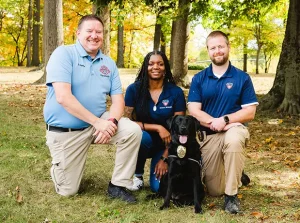
Launched in early 2020 with the support of city leadership, NobleACT is a multidisciplinary partnership between the Noblesville Police Department and Noblesville Fire Department. The program combines law enforcement officers, paramedics, a master’s-level social worker, and therapy K9 Luna into a highly adaptable Crisis Intervention Team (CIT) designed to intervene before, during, and long after a crisis call.
 At the center of the model is a simple but transformative question: What is truly driving this crisis, and what will prevent it from happening again? That question has become the foundation of one of the region’s most progressive Community Paramedicine-Mobile Integrated Health (CP-MIH) programs.
Traditional emergency response systems are highly effective at stabilizing immediate threats, but they are inherently limited by the short amount of time providers can remain on scene. Compounding that challenge is a fragmented healthcare and social service system, where individuals with complex behavioral, medical, and social needs often struggle to navigate disconnected providers, delayed access to treatment, and inconsistent follow-up care. The result is a cycle in which the same residents repeatedly return to crisis.
NobleACT was intentionally designed to interrupt that cycle. The program operates through a triad model that integrates public safety, advanced medical care, and clinical social work into a single response framework. This structure allows the team to move fluidly between law enforcement, EMS, and behavioral health functions depending on the circumstances of the call. Rather than addressing only the immediate incident, the team is built to identify root causes, develop trust with clients, and create long-term pathways to stabilization.
What sets NobleACT apart from many other CP-MIH programs is its equal partnership between police and fire services. While many community paramedicine initiatives are housed solely within fire or EMS agencies, NobleACT’s jointly supported structure expands the team’s access to resources, improves information sharing, and strengthens its ability to respond comprehensively.
The team can be activated through direct 911 dispatch, self-dispatch based on live call monitoring, requests from on-scene police or fire personnel, referrals from hospitals and community partners, or direct requests from residents and family members. Its response model is intentionally flexible, allowing team members to be deployed in different combinations depending on the needs of the situation. In some cases, a paramedic and social worker may respond together; in others, a police officer and therapy dog may be the most effective pairing. This adaptability has become one of the defining innovations of the program.
A particularly groundbreaking element of NobleACT is K9 Luna, believed  to be among the first police therapy dogs in Indiana whose primary mission is direct response to active 911 crisis calls. Luna accompanies the team into homes, roadside scenes, medical calls, and follow-up visits, serving as an immediate therapeutic bridge. Her presence helps reduce anxiety, lower emotional intensity, and create the conditions for meaningful dialogue. For clients who may otherwise respond with fear, distrust, or resistance, Luna often becomes the first point of connection.
From Crisis Response to Long-Term Stabilization
NobleACT’s impact is most evident in its ability to provide care across the full crisis continuum. The team uses proactive data analysis, frontline observations, and community referrals to identify concerns before they escalate into emergencies. During active crises, the team monitors police and fire dispatches and self-deploys to incidents involving behavioral health, addiction, homelessness, domestic violence, chronic illness, falls, juvenile issues, and high-frequency 911 utilization. Once the immediate crisis is stabilized, the work continues through intensive case management, with some clients receiving support for days, weeks, or even months until they are securely connected to long-term community resources. This continuity of care is where the CP-MIH model delivers some of its greatest value.
The average NobleACT case remains open for approximately 12 days, though more complex situations can require significantly longer engagement. In one case, the team spent nearly a year working alongside an older adult who had multiple arrests, severe addiction issues, no family support, and was living out of a broken-down truck during winter. Initially distrustful and unwilling to accept help, the individual repeatedly turned the team away. NobleACT remained consistent. Team members conducted daily visits, bringing food, water, warm clothing, heating supplies, and most importantly, a reliable presence. Over time, that consistency built trust. Through coordinated work with community partners, the team addressed the individual’s medical needs, addiction treatment, financial support, and housing instability. Eventually, the client entered treatment, secured financial assistance, and transitioned into assisted living, with NobleACT helping furnish the new apartment. It is a powerful example of what innovation in community paramedicine looks like when success is measured not by transport volume, but by lives stabilized and futures rebuilt.
Measurable Outcomes and a Scalable Blueprint
The measurable outcomes are equally compelling. In the first quarter of 2026 alone, NobleACT recorded 540 client encounters and opened 265 new cases, with 72 percent closing in successful dispositions. During the same period, the city saw a 30 percent decrease in emergency detentions compared to the first quarter of 2025, a strong indicator that earlier intervention and coordinated follow-up are reducing the need for higher-acuity responses. Since its launch, the program is conservatively estimated to have served approximately 8,000 unique clients.
The operational benefits extend beyond patient outcomes. By assuming responsibility for crisis scenes and longer-term follow-up, NobleACT allows patrol officers and EMS crews to return to service more quickly, strengthening public safety coverage while reducing repeated system utilization. The downstream effects include fewer repeat 911 calls, fewer unnecessary transports, reduced avoidable emergency detentions, and lower investigative and response costs.
Perhaps the most important lesson from NobleACT is that no single agency can effectively solve complex community health and safety challenges alone. The program’s success is rooted in the relationships it has built across police, fire, EMS, social work, hospitals, nonprofits, housing partners, and city leadership. That collaborative infrastructure has fundamentally transformed how Noblesville responds to behavioral health and social crises.
Looking ahead, the program plans to expand staffing into nights and weekends, strengthen on-call coverage, and introduce in-house counseling services to bridge the gap between referral and treatment initiation.
For communities nationwide exploring the next evolution of community paramedicine and mobile integrated health, NobleACT offers a compelling blueprint: begin with the gaps in care, build across disciplines, earn frontline trust, and design systems around the whole person rather than the isolated emergency. NobleACT is proving that when public safety and healthcare truly integrate, communities become not only safer, but healthier, more resilient, and more humane. HealthCall is honored to support programs like NobleACT and help turn this vision into real-world impact.